
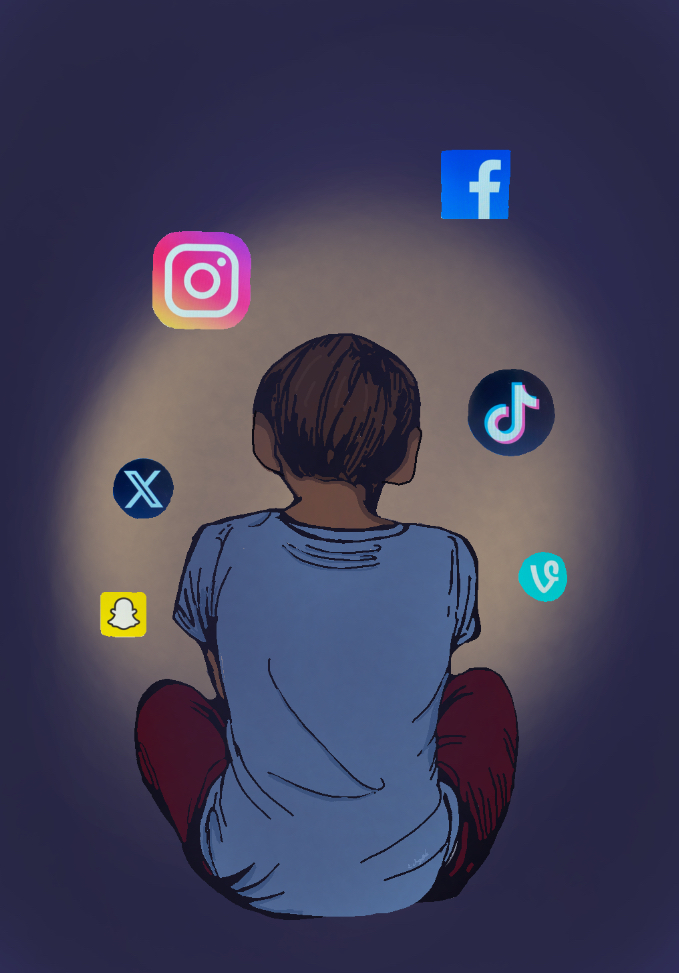
Before the mid-to-late 2000s, people used to get their news from newspapers, radios, and television. Newspapers were popular because they were widely available, inexpensive, and covered local, national and international news. Newspapers were delivered to people’s homes, or they could pick them up at newsstands. Families would gather up in front of the radio to listen to news reports, and television offered both auditory and visual elements. People could see historical events happen live.
The launch of Facebook in 2004 slowly shifted the way people got their news, and with the launch of Twitter two years later, more people turned toward social media to receive their news. It was more direct and made it possible for people to interact with their news through comments and to share the news to discuss with each other.
Now, at Warren Central, students get their news from a variety of sources.
“I typically get my news from teachers, other students, a little bit of social media and then mostly from my mom,” senior Allison Jeffries said.
In the mid-2010s, news consumption on platforms like YouTube and Instagram began, and by 2022, Instagram had become the most popular news source for young people in some regions.
“If I use social media, it’s usually Instagram,” Jeffries said.
When TikTok launched in 2016, there was a rise in news influencers as news shifted to short-form videos. According to the Pew Research Center, TikTok has become a news source for a fifth of the adults in the US, which increased from 3% in 2020.
Social media is more appealing as a news source because of its convenience, accessibility and visually engaging format. It is known that platforms like TikTok, Instagram and YouTube prioritize visual storytelling with graphics and images that are more engaging than text-heavy articles.
“Social media is easy to scroll through, get quick news, and you don’t have to read a whole article,” Jeffries said.
Despite the shift in news consumption, traditional news outlets are still widely popular among older age groups. According to the Pew Research Center, Americans who are 50 or older are more likely to turn to television or print publications for news than younger adults. Studies show that news consumption varies by age, gender, race, ethnicity and educational background.
There are also students at Warren Central who prefer traditional news outlets.
“I like to use PBS a lot ‘cause I feel they don’t take sides, so I feel like I’m getting more information,” senior Leila Fowler said.
Many factors can influence someone’s choice of news source. It all depends on what the individual values most.
"I would say [I value] mostly accuracy because I know there's a lot of bias in most newspapers, so I try to focus on one that sticks to the facts," Fowler said.
The shift in news consumption has impacted legacy media in several areas, including declining revenue, increased competition for audience attention and diminished credibility. Many of them have established online presences and often offer free content to attract readers, but this has made it hard to monetize their content effectively.
“Well, it used to be that papers made a lot of money on classified ads,” English and journalism teacher Kathleen Schuckel said. “That was a big part of their revenue. And then fewer people read the paper version of the newspaper, which made other advertisers flee because there weren't enough people reading and seeing their big ads. It really took away a lot of money from them.”
Competition has increased significantly as independent content creators and new media organizations reach a larger audience than traditional media. As professionals who went to school to study journalistic newsworthiness and ethics, traditional media employees used to be the ones who decided what was and wasn’t considered news, but now, there are a great number of content creators on different platforms from which someone can get their news. It gives the audience multiple options, which makes it challenging for traditional media to keep their attention.
“It's more of a popular contest,” Schuckel said. “What everybody worries about is how many hits something gets.”
Social media allows information to spread quickly, but the speed and reach of those platforms also enable misinformation to grow just as fast. This has weakened the public’s trust in all media institutions, including the traditional ones. This growth in false information shows why fact-checking news is important.
“You can be more in-depth with traditional media, whereas others are fleeting,” Schuckel said.
As more people turn to social media for their news, the way they receive information will continue to evolve. Legacy media were popular because they were widely available and inexpensive, but the surge in social media use has shifted how people get their news. Though there are still people who prefer traditional news outlets, this change has forced many of them to adapt to the evolving world of technology and social media. Using social media as a new source can be useful, but it requires caution and critical thinking.
“That's what education is,” Schuckel said. “It's getting in the mindset to be curious and to dig for information.”